You book a room, the listing promises a gym and pool, and you arrive to find a fitness closet with one treadmill and a plunge pool the size of a bathtub. If you’ve been burned by this before, you already know how misleading hotels with gym and pool listings can be. The photos look great, but they rarely tell you the pool’s length, depth, or whether it’s even open during your stay.
This guide shows you how to separate genuine fitness facilities from clever marketing. We’ll explain why listings mislead, how to verify pool size, depth, and hours before you book, and what to look for in a real gym, from equipment to access times. You’ll also learn how to use reviews and guest photos as evidence, which hotel types actually deliver on their promises, and the booking strategies that help fitness-focused travelers avoid disappointment.
Why Hotel Gym and Pool Listings Often Mislead
If you’ve ever booked a hotel that promised a pool and arrived to find something barely bigger than a bathtub, you already know the problem. Booking sites label almost any water feature a “pool,” whether it’s a plunge pool, a splash pad or a children’s paddling pool that’s under 15 meters long. The word alone tells you almost nothing about whether you can actually swim.
The same applies to gyms. Some properties list a “fitness center” that turns out to be a single treadmill and a yoga mat squeezed into a converted guest room. That’s technically exercise equipment, but it won’t survive the first morning when three guests all want a workout before breakfast.
Old Photos and Copied Descriptions
Photos add another layer of confusion. Images on booking sites can be 5-10 years old, showing facilities that have since shrunk, moved to a smaller space or closed entirely. That sparkling pool in the gallery might have been filled in and replaced with a sun deck two renovations ago.
Descriptions are no more reliable. Third-party listing text is often copied straight from the hotel’s own marketing copy rather than verified by anyone who has actually seen the facilities. If the hotel calls a knee-deep soaking tub a “relaxation pool,” that wording gets repeated across every booking platform without question.
The takeaway is simple: treat the words “pool” and “gym” in any listing as a starting point, not a guarantee. They tell you something exists on the property, but rarely what it’s really like or whether it’s still there.
How to Verify Pool Size, Depth and Hours Before You Book
The fastest way to find out whether a hotel pool is actually swimmable is to check the hotel’s own website, not the booking platform. Many hotels list the pool’s length in their facilities specifications, and a length of 20-25 meters means you can swim real laps. Anything shorter is likely a leisure or plunge pool where you’ll manage little more than a few strokes before hitting the wall.
Depth tells you just as much. A proper swimming pool is usually 1.2-1.5 meters deep, which suits adult swimmers comfortably. If the listed depth is 0.5-0.8 meters, you’re looking at a children’s pool, no matter how impressive the photos appear.
Opening hours matter too, especially if you like to swim early or late. Business and resort hotels typically open their pools from 6-7 am to 9-10 pm, but some properties close for private swim clubs or lessons at certain times, so ask whether lanes are reserved during your stay.
Finally, confirm the pool’s setup before you commit. When you contact the hotel, ask about these details:
- Indoor, outdoor or heated: an outdoor pool in a temperate climate may close completely during colder months, so ask if it stays open year-round or is heated in winter.
- Maintenance schedule: many pools close for 1-2 weeks a year, often in low season, so check whether your dates overlap with planned work.
- Lane availability: ask whether swim clubs, schools or aqua fitness classes regularly book the pool during the hours you plan to swim.
- Towels and changing facilities: confirm whether these are provided poolside or whether you need to bring your own from your room.
Checking the Gym: Equipment, Space and Access
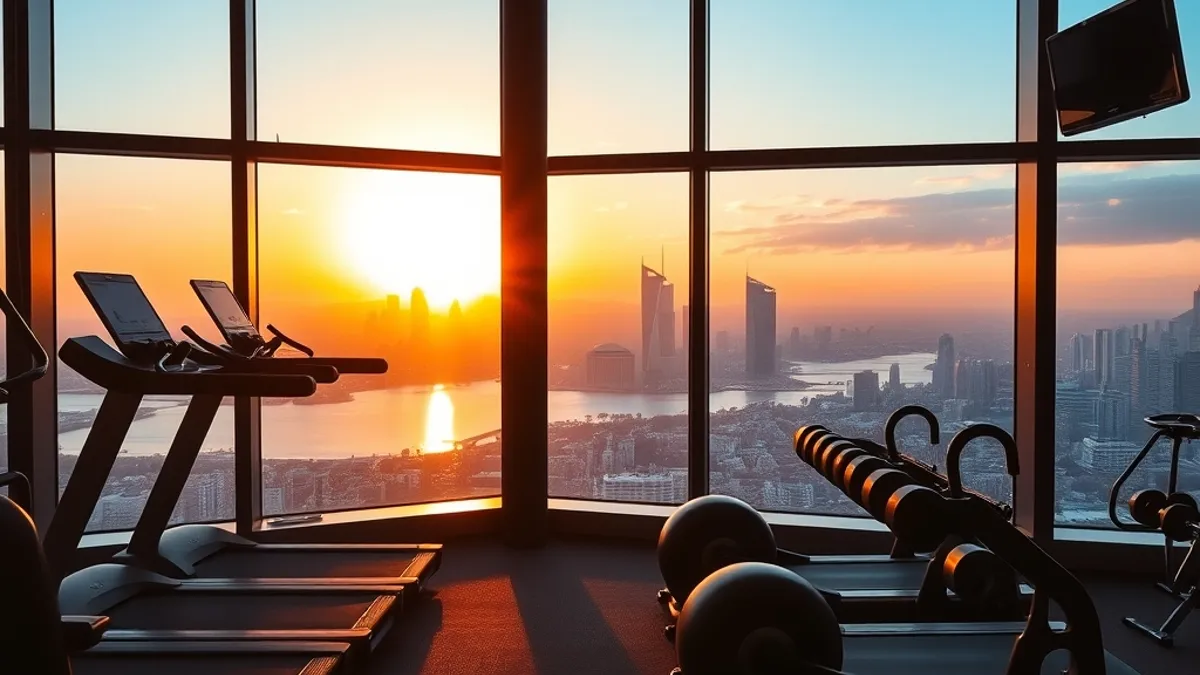
A genuine hotel gym is a proper room, not a corner with a treadmill. As a rule of thumb, look for a space of roughly 40-60 square meters with at least 5 cardio machines — treadmills, ellipticals, stationary bikes — plus a set of free weights and ideally a bench or two. Anything smaller than that usually means you will be waiting for equipment, especially if you travel when business guests are also working out.
Listing photos are not a reliable way to judge this. Instead, send the hotel a short email and ask for a current equipment list: how many treadmills, whether dumbbells go up to a usable weight, and if there is a cable machine or squat rack. A hotel that answers quickly and specifically is usually one that takes its fitness facilities seriously. Vague replies like “we have a fully equipped gym” often mean the opposite.
Access hours matter just as much as equipment. Many hotel gyms run 24 hours a day, which is ideal for early flights or jet lag, while others operate roughly 6 am to 10 pm, sometimes with staffed hours only in the middle of the day. If your routine depends on a 5:30 am session, confirm in writing that the gym is actually open at that hour.
- Ask whether dumbbells reach heavier weights — many hotel gyms stop at light pairs, which limits any strength work beyond warm-ups.
- Find out if the gym is card-accessed around the clock or only reachable when staff are present, since this changes what early morning or late night sessions are possible.
- Check whether towels and water are provided in the gym itself, because some hotels expect you to bring your own from the room.
- Confirm there are changing rooms with showers next to the gym, so you can work out after checking out without returning to your room.
- If you follow a specific routine, ask whether extras like a yoga area, mats or a stretching zone are part of the space.
Using Reviews and Guest Photos as Evidence
Official listing photos tell you what a hotel looked like years ago. Reviews and guest photos tell you what it looks like now. The trick is knowing how to dig through both quickly, because scrolling hundreds of comments is a waste of time if you go about it randomly.
Search reviews with keywords
Most booking sites and review platforms let you filter or search reviews by keyword. Type in “pool”, “gym” and “fitness” one at a time and read what comes up. You are hunting for specific complaints: a pool too small for laps, a gym that closed months ago, equipment that is broken or missing. A single grumpy review means little, but three or four guests mentioning the same problem is a pattern worth taking seriously.
Trust recent guest photos over official ones
Photos uploaded by guests within the last 6-12 months are your best evidence of the current state of a facility. Official images can be 5-10 years old, taken before a renovation downsized the gym or turned part of the pool area into a sun deck. Guest shots are usually unflattering, wide-angle-free and honest, which is exactly what you want. Look closely at the equipment visible in gym photos and the water level and surroundings in pool shots.
Pay attention to two more signals. First, repeated mentions of maintenance closures, which often last 1-2 weeks and tend to happen in low season, can wreck a fitness-focused trip if they land on your dates. Second, check whether reviewers complain about crowded pools or queues for treadmills at peak times, especially at conferences or during holidays. If several guests mention waiting for a machine, plan your workouts accordingly or pick another hotel. For a broader sense of which properties consistently look after their guests, browse some hotels celebrated for outstanding guest service and use their review patterns as a benchmark.
Choosing Hotel Types That Deliver Real Fitness Facilities
Not all hotels treat fitness facilities the same way, and the differences come down to who the hotel is trying to attract. Once you understand which property types genuinely need a good gym and pool to win bookings, you can shortcut much of your research.
Property types that rarely disappoint
Business hotels and airport hotels are the safest bets. Their regular guests travel with workout clothes packed by habit and expect to swim laps or run on a treadmill before meetings, so these properties almost always maintain genuine gyms and proper lap pools. Large resort properties are another strong option: they typically offer both a main pool of 20-25 meters suitable for swimming and separate leisure pools for families and relaxation, giving you the best of both worlds.
Where you need to double-check
Boutique and design hotels frequently skip full fitness facilities altogether. They pour their budget into interiors, restaurants and atmosphere, and a “gym” may be little more than a corner with a stationary bike. That is a perfectly good trade-off if you value design over dumbbells, but verify before you assume. Check the property’s own website for facility details, or email them directly for a current equipment list.
Be realistic about cost, too. Full-service hotels with genuine fitness and swimming facilities typically charge 15-30% more per night than basic properties. If a deal looks dramatically cheaper than comparable hotels in the area and still lists a gym and pool, treat that as a prompt to verify rather than a reason to celebrate. The price gap usually reflects real differences in what is behind the amenity list.
Booking Strategies for Fitness-Focused Stays
Once you have identified a hotel with promising facilities, a few simple steps before you pay can save you from arriving to a drained pool or a gym behind plastic sheeting. None of these steps takes more than a few minutes, and together they form a checklist you can run through for any property you are considering.
- Contact the hotel before you book. Ask specifically whether both the pool and the gym will be open on your exact dates, not just in general. Front desk staff know the maintenance schedule; booking sites do not.
- Request a room close to the pool or gym. If morning workouts matter to your routine, a short walk down the corridor makes the difference between a 6 am swim and hitting the snooze button. Mention it when you book or follow up by email so the request is on record.
- Avoid likely maintenance windows. Pools commonly close for maintenance during low-season months like November or February. If your dates are flexible, shifting a few days can keep your training plans intact without any extra cost.
- Read the cancellation terms carefully. Choose a rate that lets you cancel or change without penalty, so you can rebook elsewhere if the hotel later confirms a facility closure during your stay.
These steps take maybe twenty minutes in total, which is a small investment for a trip where your schedule depends on the hotel keeping its promises. Keep a short note of who you spoke to, on what date, and what they confirmed in writing. If a facility later closes unexpectedly, that record gives you something concrete to reference when you ask for a room change, a rate adjustment or a penalty-free cancellation. It also makes any follow-up email far more effective, because you are not relying on memory or a verbal promise from a shift that has long since ended.
Wrapping Up Your Search for Genuine Gym and Pool Hotels
Finding a hotel with a real gym and a swimmable pool comes down to one habit: verify before you pay. Check the pool’s length, depth and opening hours, and make sure the gym covers a proper 40-60 square meters with 5 or more cardio machines. A listing photo can be 5-10 years old, so lean on recent guest photos and reviews rather than the official images to see what the facilities actually look like today.
When in doubt, favor business hotels and large resorts, which tend to maintain genuine fitness facilities for their regular guests, and confirm everything directly with the hotel before booking. A short email about your exact dates is the simplest way to avoid the disappointment of a fitness closet and a bathtub-sized plunge pool waiting for you at check-in. If you’ve had a hotel gym or pool surprise you, share your story in the comments or pass this article along to a fellow traveler.