Almost every resort listing mentions a pool, but the word alone tells you very little. Resort pools come in three very different forms — lagoon, infinity and lap — and each one shapes your stay in its own way. A family with toddlers, a couple chasing sunset photos and a traveler who swims laps every morning are not looking for the same water.
This guide walks through what defines each pool type, from freeform lagoon curves to vanishing edges and 25-meter lanes. You’ll learn how to match a pool to your travel style, how to spot the type before you book, and which practical differences — from morning hours to occasional maintenance closures — guests actually notice once they arrive.
What Defines a Lagoon Pool
A lagoon pool is the opposite of a rectangle. It spreads across the grounds in freeform, organic curves that mimic a natural lagoon, often edged with sand or zero-depth entries so you can walk straight into the water the way you would at a beach. There are no lane lines and no hard corners — just winding shorelines, palm islands and water that seems to flow wherever the landscape wants it to.
Size and layout
These pools are big. A typical lagoon pool spans 2,000-10,000+ square meters, which is why you’ll often find small islands in the middle, wooden bridges crossing narrow channels and swim-up bars tucked along one curve. The sheer scale matters as much as the shape: even when the resort is full, the water rarely feels crowded.
Depth follows a gentle gradient. Shallow zones of 30-60 cm sit near the edges, deepening gradually toward the center, so small children can splash safely at the rim while stronger swimmers head inward.
Where you’ll find them
Lagoon pools are the signature of large beach and family resorts, where the pool doubles as the social hub of the whole property. Expect poolside activities, bars and loungers concentrated around it — it’s the place guests gather rather than pass through.
What Makes an Infinity Pool Different
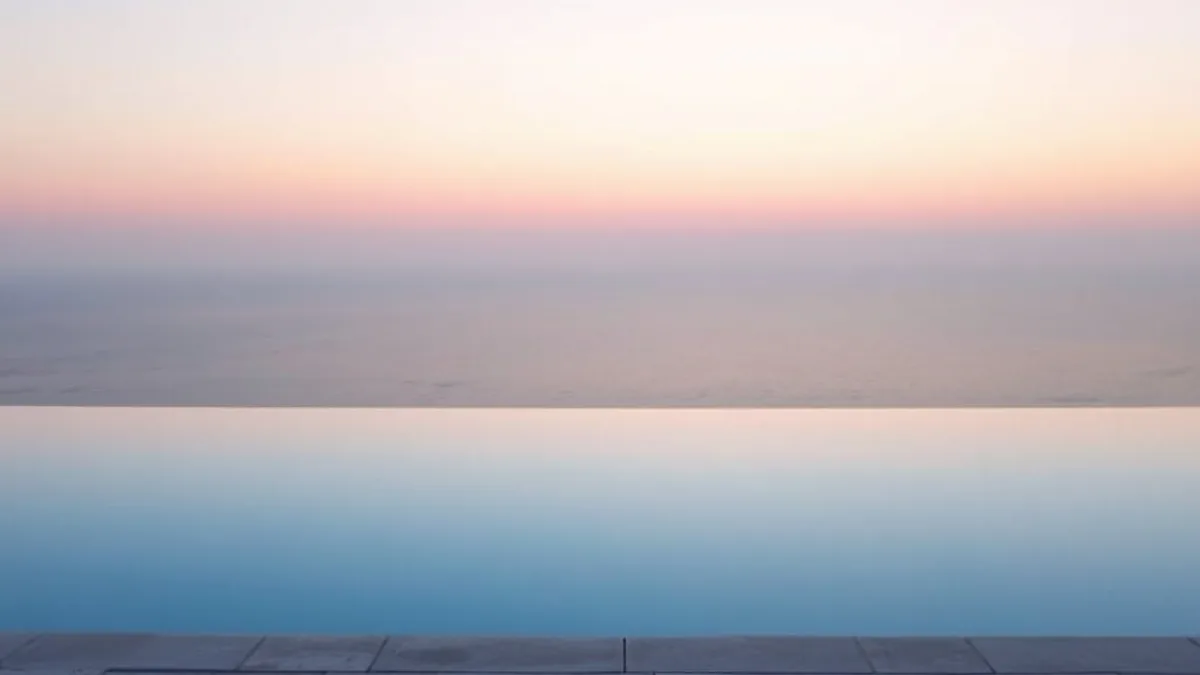
An infinity pool is built around a single visual trick: a vanishing edge. Water flows over one border of the pool into a hidden catch basin below, so the surface appears to merge seamlessly with the ocean, jungle or skyline beyond it. From the right angle, you can’t tell where the pool ends and the horizon begins.
Why location is everything
The effect only works from an elevated or cliffside position, with a level horizon in the distance. That’s why infinity pools usually sit on upper floors or cliff edges rather than at ground level, and why they’re rare on flat, inland properties. If the view drops away or the horizon line is broken, the illusion falls apart.
Unlike lagoon pools, these are usually smaller and deeper, built for views and photos rather than play. There’s no shallow splash zone or swim-up bar maze — the pool exists so you can float at the edge and watch the world below. For travelers who choose hotels for the view alone, suites with an infinity pool overlooking the skyline show just how far properties will go to claim that edge.
The cost behind the edge
That hidden catch basin and precision engineering come at a price: construction costs roughly 15-30% more than a standard pool of the same size. This is why vanishing edges appear almost exclusively in luxury properties, where the pool is part of the view the room is sold on.
Why Resorts Build Lap Pools
Lap pools exist for one reason: uninterrupted swimming. The standard design runs 25 meters long with a depth of 1.2-1.5 meters, which gives you enough room for full strokes and turns without touching the bottom. No curves, no islands, no distractions — just a straight line of water made for training.
Designed for quiet, not lounging
The rectangular design includes lane markers, and placement matters as much as shape. Resorts position lap pools away from noise, bars and children’s areas so swimmers can keep a steady rhythm without dodging inflatables or cannonballs.
Many properties go further and make the lap pool an adults-only or designated quiet zone, often with early-morning access before the rest of the resort wakes up. If you like swimming at dawn, this is the pool that will actually be open and empty.
Where you’ll find them
Lap pools are the signature of wellness, spa and urban resorts, where guests train rather than lounge. They pair naturally with fitness centers, spa programs and business hotels where a morning swim replaces a gym session. If your vacation routine includes actual swimming — not just floating — a resort with a proper lap pool is worth seeking out, because a decorative freeform pool rarely offers the length or calm you need for real laps.
Choosing a Pool Type for Your Travel Style
The pool you choose shapes your entire resort day. A family camped at a shallow edge has completely different needs from a couple chasing a sunset photo, so it pays to match the water to your travel style before you book rather than after you arrive.
If you travel with young children, a lagoon pool is hard to beat. The zero-depth entries let toddlers wade in gradually just as they would at a natural beach, and shallow play zones mean you can stand comfortably beside them almost everywhere. Parents get shade, space and no scrambling over pool ladders.
Couples and photographers should aim for an infinity pool instead. The magic happens at sunrise or sunset, when the water line blends with the sky and the horizon seems to dissolve into the pool itself. Book a room category that includes pool access at those hours, since the best light lasts less than an hour.
Fitness-focused travelers have different priorities again. A proper 25-meter lap pool lets you swim uninterrupted strokes, but you will still want a separate leisure pool for cooling off afterward, so look for properties that offer both rather than one shared body of water.
- Families: ask whether the shallow zone includes shaded loungers or a splash area, since shade placement matters more than pool size when you have small children.
- Couples: check whether the infinity pool sits on an upper deck or cliff edge, because elevation is what creates the vanishing effect in the first place.
- Fitness travelers: confirm whether lanes are marked and whether the lap pool opens early, since serious swimmers rarely want to wait until mid-morning.
- Mixed groups: look for resorts with two or three pool types on one property, so grandparents, kids and runners can each claim their own corner.
How to Spot the Pool Type Before You Book
Resort websites love the word “pool,” but rarely tell you which kind you are actually getting. A few minutes of detective work before booking tells you whether you should pack goggles for laps or arm bands for the kids, and it can make the difference between a trip that flows and one spent circling a crowded basin.
- Study aerial photos and satellite views. Freeform curves with islands and bridges point to a lagoon pool, while long straight rectangles almost always mean a lap pool. This takes about two minutes on any mapping app and settles the question faster than any brochure or glossy marketing photo ever will.
- Read room descriptions, not just property amenities. Words like “vanishing edge,” “infinity” or “horizon pool” in a room or suite description usually mean the pool sits close to your category, while a single mention on the general amenities list may refer to a small deck shared with hundreds of guests.
- Confirm depth and heating if you travel outside the warm season. An unheated infinity pool at a cliffside property can be unusable in cooler months, and lap swimmers should verify the water depth suits their stroke before assuming training is possible.
- Scan recent guest reviews for mentions of crowds. A sprawling lagoon pool absorbs people far better than a small infinity deck, so the same occupancy rate can feel spacious at one property and shoulder-to-shoulder at another. Look for phrases like “quiet in the morning” or “packed by noon” to gauge the rhythm.
One final tip: save screenshots of the photos and descriptions you find during your research. If you arrive and the “infinity pool” turns out to be a standard rectangular basin with no view at all, you will have something concrete to raise with the front desk or your booking platform, and a much stronger case for a room change or refund.
Maintenance and Practical Differences Guests Notice
Pools look identical in photos, but each type behaves differently once guests arrive. Knowing the practical quirks helps you set expectations and ask the right questions before check-in.
Infinity pools are the most maintenance-hungry of the three. The vanishing edge depends on constant water-level balancing along the overflow border, and even small drifts break the visual effect. Because of this, properties occasionally close an infinity pool for a day of maintenance, usually on short notice.
Lagoon pools face the opposite problem: sheer volume. Filtering thousands of square meters of water takes time, and after a peak weekend you may notice slight cloudiness near the busiest edges before the system catches up. It is rarely a safety issue, but it is a visible difference from a crisp hotel courtyard pool.
Why lap pools stay cleanest
Lap pools benefit from simple rectangular circulation and a lower bather load, since serious swimmers come and go rather than lingering all day. Fewer bodies in the water means fewer sunscreen residues and less debris, so the water typically stays clear with less visible intervention.
Hours worth asking about
Pool hours vary more than most guests expect. Lap pools often open at 6-7 am to serve early swimmers, while leisure pools generally run from around 8 am to sunset. Ask at booking or check-in so you can plan morning laps or an evening swim without surprises.
Wrapping Up the Three Pool Types
Most resort listings just say “pool,” but the type behind that word shapes your whole stay. A lagoon pool means space, shallow entries and family play spread across 2,000-10,000+ square meters, so kids wade in while adults relax nearby. An infinity pool trades size for views, costing 15-30% more to build, and rewards photographers who time their shots for sunrise or sunset. A lap pool delivers 25 meters of quiet, structured swimming well away from the crowd, often in an adults-only corner of the property.
Once you know which experience you want, matching the pool type to your travel style becomes the simplest way to pick the right resort. Families lean lagoon, couples and photographers lean infinity, and fitness travelers lean lap. If this helped you decode your next booking, leave a comment or share the article with a fellow traveler.