Cliffside villas promise the kind of view that makes you stop packing mid-sentence: an unbroken horizon, a caldera glowing at dusk, waves crashing far below. But the same dramatic terrain that delivers that panorama also delivers stairs, steep access roads and exposed edges, and it’s easy to worry that a dream view could turn into a stressful stay, especially if you’re hauling suitcases or traveling with kids.
This guide walks through the practical side of booking a villa on a cliff. We’ll cover why these properties cost more, what to ask about steps, roads and luggage help, how to verify the view you’ll actually get from each level, and the safety checks worth doing before you pay a deposit. We’ll also look at the best seasons and typical rates, how to match a villa to your travel style, and the trade-off in brief, so you can decide whether the climb is worth the view for your group.
Why Cliffside Villas Command Both a Premium and a Warning
The main reason cliffside villas cost more than comparable inland stays is simple: the view. An unobstructed sweep of sea, a caldera edge or a valley dropping away below your terrace is something a standard rental simply cannot replicate, and hosts price that scarcity accordingly. You’re not just paying for square footage and a pool; you’re paying for a position that can’t be built anywhere else.
What the premium actually buys
Here’s the part listings gloss over: the same terrain that creates the view also creates the logistics. Stairs replace elevators, switchback roads replace straight driveways, and exposed cliff tops mean more wind than sheltered inland spots. So the premium buys scenery plus a certain amount of planning, from luggage handling to grocery runs on narrow roads.
Understanding this trade-off up front is what separates a great booking from a frustrating one. A cliffside villa can be perfect for a couple celebrating an anniversary and a poor fit for a family with toddlers and a stroller, and neither group is wrong. The goal is to decide whether the property suits your actual group, with its real energy levels, mobility and luggage, rather than just your photo feed. The sections that follow break the trade-off into specific, answerable questions so you can book with confidence.
Access: Stairs, Roads and Luggage Reality
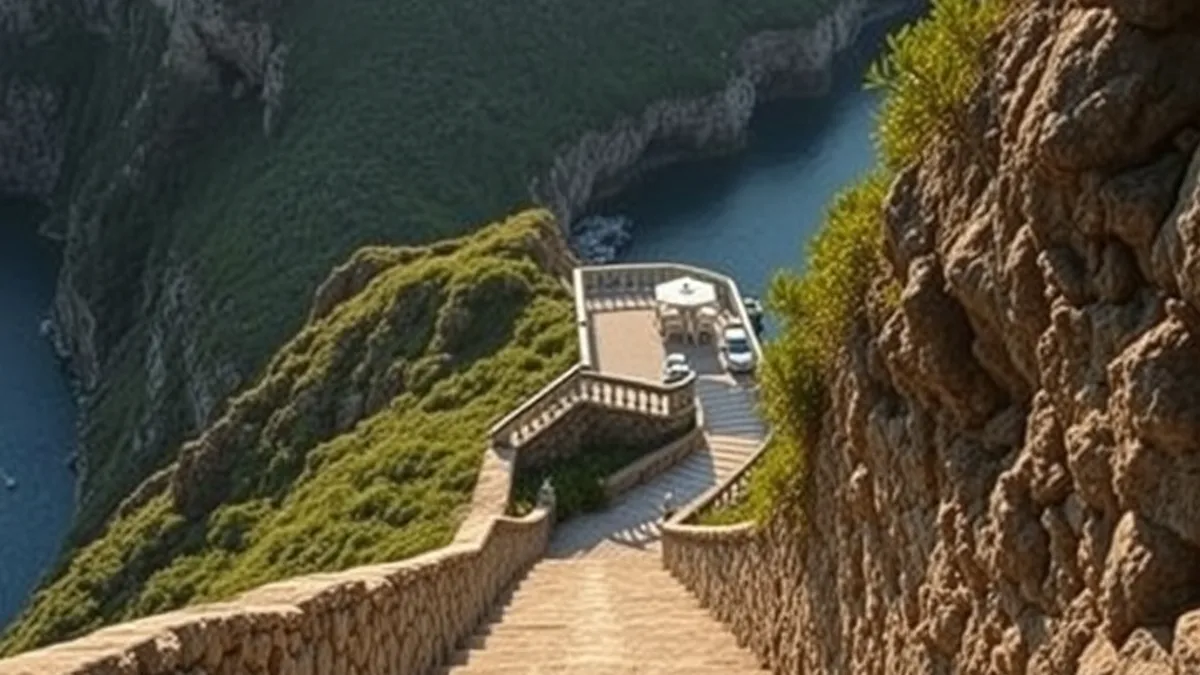
Access is the single most underestimated part of booking a cliffside villa. In places like Santorini, where the caldera cliffs rise roughly 300 meters above the sea, many villas sit 100-300 steps from the nearest road. That’s fine on arrival day with two light bags; it’s a different story with four suitcases, a stroller and a week of groceries.
So make your first question to the host a precise one: how many steps, exactly, from parking or the drop-off point to the villa door? A vague “it’s a short walk” tells you nothing. Once you have the number, confirm what luggage help exists before you commit, whether that’s porter service, a cable lift, or vehicle access to a lower gate closer to the entrance. Some properties on Santorini villas with infinity pool sunset views advertise porter service, but it often needs to be arranged in advance rather than assumed on arrival.
The road matters as much as the stairs. Some cliff roads are single-lane and steep, which affects whether a standard taxi or rental car can actually reach the door, and whether you’ll want to drive them after dark.
Questions worth putting in writing
- Vehicle access: Is the road paved, and is it wide enough for a standard taxi or a mid-size rental car to turn around at the top?
- Luggage logistics: Does the host offer porter service, a funicular or cable lift, or a drop-off point closer to the entrance, and does it cost extra?
- Step conditions: Are the stairs lit at night and covered from rain, or open to the elements the whole way down?
- Nearest parking: How far is the closest spot where you could leave a car if the road turns out to be too narrow?
If anyone in your group has limited mobility, if you’re traveling with young children, or if you’re carrying heavy dive or ski gear, treat the step count as a dealbreaker question rather than a detail. A villa that looks perfect on paper can become exhausting if every coffee run means 150 steps each way.
Views: What You Actually See From Each Level
“Sea view” is one of the loosest phrases in vacation rental listings. It can mean a full horizon panorama from a private terrace, or a sliver of blue wedged between two neighboring roofs that you can only see if you lean over the railing. Before booking, ask the host for recent photos taken from the actual terrace and pool, not from a drone or a nearby viewpoint, and ideally a short video panning across the sightline.
Match the view to the rooms you’ll actually use
Upper-level bedrooms usually get the best outlook in cliffside villas, which is great if you spend your mornings in bed with a coffee and less great if your waking hours happen in a lower living room facing a wall. Ask which rooms have the premium sightlines and match the best view to the spaces where you’ll spend the most time awake, not just asleep.
Orientation also shapes both price and experience. Sunset-facing cliffs in the Aegean and sunset-facing pools in tropical spots sell out first and command the top rates, so book early if that golden-hour moment is the whole point of the trip. East-facing alternatives typically cost less and give you sunrise over the water instead, which many travelers end up preferring for morning swims. If a west-facing ocean pool is your priority, look at options like these Phuket villas with infinity pool ocean views and confirm the exact direction of the deck before booking.
Finally, remember that visibility changes with the season. Wind and haze can soften or completely alter what you see, so a June caldera view and an October one are not the same experience. Ask the host honestly how the view behaves in the month you plan to travel, and check recent guest photos from that same period if you can.
Safety Checks Before You Book a Cliffside Villa
The same drop that gives you a postcard view is also the single biggest safety factor in a cliffside villa, so treat railings and pool edges as booking questions, not assumptions. Well-designed properties use continuous railings of roughly 1.1-1.2 meters on terraces, stair edges and pool decks as a baseline standard. Ask the host for photos of any unfenced drop, especially where a terrace or garden runs toward the cliff line, and be specific: a wide-angle marketing shot can hide exactly the gap you are worried about.
Infinity pools deserve extra attention. Many sit directly at the cliff edge for the visual effect, which is stunning but means the pool boundary and the cliff boundary are nearly the same line. If children are in your group, confirm in writing whether the pool area is fenced, gated or alarmed, and whether the villa offers any childproofing on request. For inspiration on what a well-executed hillside infinity pool looks like, browse hillside villas with infinity pools in Los Angeles and note how the best designs separate the pool deck from the drop.
- Stair lighting and surfaces: ask whether outdoor stairs have motion-sensor or switch-controlled night lighting and non-slip treads, which matters most after an evening swim, a rain shower or a glass of wine on the terrace.
- Monsoon readiness: in tropical cliff locations such as Phuket, the rainy window runs roughly May to October, so check how the villa handles downpours — proper drainage, covered walkways between bedroom and pool, and gritted or textured stone that stays safe when wet.
- Drop-off zones for kids and pets: some villas have level garden sections away from the cliff; ask which parts of the property are genuinely enclosed rather than assuming the whole plot is secure.
When to Go: Seasons and Rates for Cliff Stays
Timing shapes both the price and the experience of a cliffside stay. In Mediterranean cliff destinations, peak season runs June to September, when the caldera and coastal views are at their most reliable and rates sit at the top of the range. May and October are the sweet spot for many travelers: crowds thin out, prices soften, and the weather stays mostly stable enough for swimming and terrace dinners.
Tropical cliff coasts work on a different calendar. The best months are the dry ones outside the monsoon window, which in destinations like Phuket runs roughly May to October. Outside that stretch you get calmer seas, clearer water and terraces you can actually use in the evening.
What you should expect to pay
Premium cliffside villas typically range from about $300 to $1,500 per night, with the top of the range hit during peak weeks and in view-critical positions — think a west-facing caldera terrace or a pool aimed straight at the horizon. The same villa can shift several hundred dollars a night between June and late October, so flexibility pays.
How far ahead to book
For high season, book 3-6 months ahead; the best-positioned cliff villas are small in number and sell out early. In shoulder months, 1-2 months ahead is usually enough, and you may even find last-minute openings at reduced rates.
How to Match a Cliffside Villa to Your Travel Style
The right cliffside villa depends less on the view and more on who is climbing the stairs. Couples chasing sunsets should prioritize a west-facing terrace and simply accept the steps as the cost of the panorama — a climb you make twice a day is very different from one you make with toddlers and beach bags. Families should flip the priorities: fenced pools, step-free living areas and bedrooms that open onto a level terrace matter far more than which direction the sun sets.
Plan around the road, not just the villa
Remote cliff roads are part of the deal, and they change how you eat and shop. Restaurants and stores may be 20-40 minutes away, so plan groceries, airport transfers and dinner reservations in advance rather than improvising. Ask whether the host can arrange a grocery pre-stock, a trusted local driver or a chef for a night or two — on a switchback road after dark, you will be glad you did.
If the climb worries you
Don’t give up the view entirely. Some cliffside properties offer cable lifts, porter service or road-level entry that removes the worst of the ascent, and hosts can often assign you a villa closer to the drop-off point if you ask early. Frame your mobility needs clearly at booking — hosts deal with these requests often and can usually match you to the right unit within their collection.
The Cliffside Villa Trade-Off in Brief
Cliffside villas deliver the views that flat rentals simply cannot, and that is exactly why they cost more per night. The trade-off is real, though: stairs, access planning and higher rates all come with the panorama. The good news is that almost every stressful surprise can be filtered out before you book, not after you arrive.
Run through the key checks and the dream stay usually stays a dream. Ask for the exact step count and luggage help, request recent photos from the actual terrace to verify sightlines, confirm railings and pool safety, and pick a season that matches the weather. Book 3-6 months ahead for peak season and budget roughly $300-1,500 per night, and the view does the rest. If this helped you plan, leave a comment or share the article with a fellow traveler.