Many travelers picture a luxury tent as something you enjoy under a warm summer sky, yet glamping in winter has quietly become one of the fastest-growing corners of the travel world. Resorts across the Arctic, the Alps and beyond now fill their heated domes and canvas lodges on snowy nights, when temperatures drop well below freezing. That raises an obvious question: how does a tent stay cozy when it is -20°C outside?
The answer is a mix of clever engineering and serious heating, and it is more interesting than you might expect. In this article, we look at why winter glamping is a different discipline from summer camping, how multi-layer tent walls and geodesic dome design handle snow and cold, and what stoves and underfloor heating bring to the inside. We will also cover the best destinations and seasons, plus practical advice on booking ahead and packing for short winter days. By the end, a night in a snow-covered dome will sound a lot less crazy.
Why Glamping in Winter Is Different From Summer Camping
If you have camped in summer, forget most of what you know. Winter glamping sites face three challenges that simply do not exist in July: heavy snow piling onto roofs, ground that stays frozen solid for months, and temperature swings of 30°C or more between a sunny afternoon and the middle of the night. A structure that copes with a mild breeze and a cool evening would struggle badly in those conditions, which is why cold-weather units are built and operated differently from the ground up.
When daylight becomes a design constraint
Daylight is the other big difference. In Nordic midwinter, Arctic destinations get roughly 4-6 hours of usable light per day, so these stays plan around darkness rather than ignoring it. Expect warm exterior lighting paths between units, cozy interior lamps, fire pits and indoor activities that feel inviting at four in the afternoon. Operators design the whole experience, from dinner timing to northern-lights viewing, around the fact that the sun barely makes an appearance.
Demand has shifted too. Winter used to be the shoulder season for many cold-climate glamping sites, a quiet gap between summer peaks. Today it is peak season for a growing number of them, with heated domes and snow-viewing lodges booked out months in advance. That popularity is good news for the quality of the experience — operators have refined their winter setups over multiple seasons — but it also means you need to plan ahead rather than expect a last-minute snowy escape.
The Engineering Behind Cold-Weather Glamping Tents
The first secret of a warm winter tent is what the walls are made of. Instead of the single thin layer you find on a summer tent, cold-weather glamping tents typically use multi-layer canvas combined with thermal liners, and the layers are separated by an air gap of around 5-10 cm. That trapped air is a surprisingly effective insulator, slowing heat loss dramatically compared to a single skin. Just as importantly, canvas breathes: moisture from your breath and from cooking escapes through the fabric instead of condensing on the walls, which keeps the interior drier and more comfortable.
Frames and roofs built for snow
Snow is heavy, and a roof that sags under it becomes a problem fast. Winter tents therefore rely on reinforced frames — often sturdier center poles and thicker structural members than their summer cousins — paired with steep roof angles that encourage snow to slide off rather than accumulate. A summer tent pitched in the same spot after a heavy snowfall could collapse under the load; a properly engineered winter unit sheds it continuously.
The third element sits underneath you. Frozen ground is often the biggest source of heat loss in a winter structure, because your body loses warmth to whatever it touches far faster than to the air. That is why most serious cold-weather glamping units sit on elevated wooden platforms. The platform lifts the floor off the frozen surface, creates an insulating buffer of still air beneath, and gives you a solid, dry, level floor to walk on even when everything outside is ice. Together, layered walls, a snow-shedding frame and a raised floor turn what looks like a tent into something that behaves much more like a small cabin.
Heated Domes: Geodesic Design Meets Sub-Zero Comfort
If layered canvas is the classic answer to winter, the geodesic dome is the modern one, and its shape is not just for looks. A dome’s triangular geometry distributes weight evenly across the whole structure, so snow that settles on top is carried by many panels at once rather than concentrating on a single weak point. That same geometry handles wind well, an important trait in the exposed, treeless winter landscapes where many dome resorts are pitched. Where a flat or shallow roof fights the elements, a dome sheds and spreads them.
Free heat from a low sun
Domes also make smart use of a resource winter does provide: sunshine, even if it arrives at a shallow angle. Many winter domes combine clear or translucent panels on the sun-facing side with insulated panels covering the rest. The transparent sections let low winter sunlight pour in and create passive solar gain — free warmth during the few bright hours of the day — while the insulated sections hold that warmth in once the sun drops. It is a simple idea that works remarkably well in cold, clear weather.
The result can be startling the first time you experience it. A well-built heated dome can hold interior temperatures of 20°C or more even when the thermometer outside reads -20°C to -30°C. Step in from a snowy evening, and you go from breath-freezing cold to shirt-sleeve comfort in a few seconds. That contrast, standing in a warm, light-filled dome while snow falls outside the panels, is exactly what has made geodesic glamping the signature winter experience it is today.
Heating Systems: Stoves, Underfloor Heat and Zoned Warmth
When the temperature outside drops well below freezing, heating becomes the difference between a magical night and a miserable one. Most winter glamping sites build their entire experience around one or more heat sources, and knowing how each works helps you choose the right unit.
Wood stoves: the classic heart of a winter tent
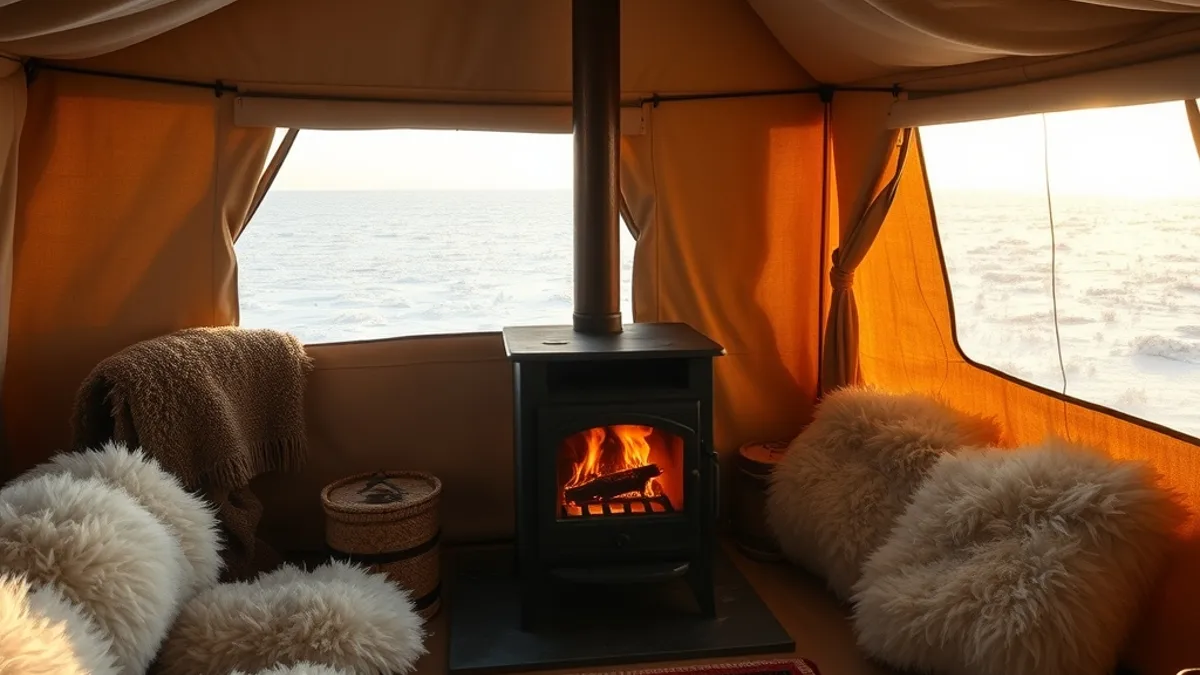
The wood-burning stove is the traditional solution, and for good reason. A properly sized stove can raise the interior temperature by 15-25°C above outdoor levels, which turns a -15°C night into a cozy reading corner. The stovepipe runs through a heat-resistant collar in the roof or wall, and operators typically supply a stack of seasoned logs for the night.
There is also the ambience factor. The crackle and glow of a real fire is part of what people pay for, and many guests say the stove is their favorite feature of the whole stay. The trade-off is practical: the fire needs feeding every few hours, so deep-night warmth depends on either a long burn or someone getting up to add logs.
Electric and underfloor heat for all-night comfort
Higher-end domes solve the refuelling problem with electric heaters or underfloor heating. Underfloor systems are especially pleasant in a dome, where you often step from bed onto a cold surface first thing in the morning. With heated floors, that first step is warm, and the heat keeps running overnight without anyone tending a fire.
The best setups use zoned heating, which treats different corners of the unit as separate comfort areas. Your sleeping zone stays cool enough for good sleep, the bathroom stays toasty for showers, and a glass lounging corner can sit somewhere in between. Ask the operator how the unit is heated when you book, because the answer shapes how your night actually goes.
Where to Go: Best Winter Glamping Destinations and Seasons
Winter glamping has spread across both hemispheres, and each region puts its own spin on the cold-weather stay. The Northern Hemisphere season generally runs from November to March, while southern destinations flip the calendar entirely. Here is where to start looking.
Nordic countries: Arctic domes and northern lights
Iceland, Norway and Finnish Lapland are the flagship destinations for heated geodesic domes. These sites are positioned for dark, clear skies, and the northern lights are the main event from November to March. With midwinter daylight this far north being famously brief, operators design stays around evening activities: aurora watching, sauna sessions and long dinners under glass roofs.
The Alps: tents with ski lifts nearby
Alpine regions in Switzerland and Austria pair winter tents and domes with proper ski infrastructure. You can spend the day on the slopes and sleep in a heated dome the same night, often with spa access thrown in. For a sense of how refined an Alpine winter stay can be, see indulging in Alpine grandeur at The Chedi Andermatt, Switzerland, a resort that shows what the region does at the top end.
Heading south for the off-season
If your travel window is the Northern Hemisphere summer, the southern hemisphere takes over. Patagonia and New Zealand run their cold season from June to August, offering snowy landscapes, fewer crowds and the same heated-dome engineering. Availability is thinner than in the Nordics, so check operator seasons carefully before committing to dates.
- In Finnish Lapland, some dome sites sit inside or near reindeer country, so husky sledding and reindeer farm visits slot naturally into a stay.
- Icelandic locations often combine aurora viewing with geothermal bathing, since natural hot springs are never far from the ring road.
- Austrian Alpine sites tend to be smaller and family-run compared with Swiss operations, which can mean a quieter, more personal experience.
- Patagonian winter stays put you close to glacier country, with ice trekking and frozen-waterfall scenery as daytime anchors.
- New Zealand’s South Island offers cold-season glamping near lake country, where frosty mornings and mirror-calm water make for striking photos.
How to Book and What to Pack for a Winter Glamping Trip
Winter glamping rewards planners. Heated domes are limited in number, the high season is short, and the best sites sell out well before the first snow falls. A little preparation on both the booking and the packing front makes the whole trip smoother, and it usually costs you nothing but a few emails.
- Book 3-6 months ahead for December-February dates. Winter is now peak season at many cold-climate sites, and heated geodesic domes typically run $250 to $800 per night in high season. The earlier you reserve, the better your pick of units, layouts and dates. If you want a dome with a clear stargazing panel or a private hot tub, those features go first.
- Confirm the temperature rating and heating type before you pay. Four-season tents are typically rated down to -20°C to -30°C, but not every unit suits every climate. Ask whether the heat comes from a wood stove, electric heaters or underfloor systems, since that determines whether warmth lasts all night without you getting up to refuel.
- Check what is included. Some operators supply bedding, firewood and meals; others expect you to bring more than you would think. A quick email before booking avoids surprises on arrival, especially if the site is remote.
- Pack for the outdoors, not just the tent. Thermal base layers, wool socks and insulated boots are essential, because you will be stepping outside for aurora watching, hot tubs or the walk to dinner. Bring a headlamp too, since midwinter days in Nordic latitudes are short on light.
One last tip: build some flexibility into your travel dates if you can. Weather in Arctic and Alpine regions can shift quickly, and operators occasionally adjust check-in times or activities around storms. Travelers who arrive with the right gear and realistic expectations tend to have the best experience, and the ones who booked early usually got the dome with the best view.
The Warm Truth About Cold-Weather Glamping
So how do luxury tents and domes stay cozy when the thermometer drops well below freezing? The answer comes down to three things working together: layered insulation that traps heat while letting moisture escape, geodesic engineering that shrugs off snow and wind, and heating systems serious enough to keep interiors comfortable in temperatures rated down to -30°C. A wood stove crackling in the corner does more than warm the air — it turns a night at -20°C outside into something you actually look forward to.
The other half of the equation is timing. The coldest months are also the busiest ones for cold-climate glamping sites, and the best heated domes for December-February dates tend to disappear if you wait. Book 3-6 months ahead and the whole trip feels seamless rather than stressful. Have you tried a winter glamping stay, or are you tempted? Leave a comment or share this article with someone who needs a snowy escape.