Picture this: you have found the perfect safari lodge, the photos are stunning, and you are ready to hit book. Then it hits you — nobody mentioned whether the area is a malaria zone, or what the lodge actually does to protect guests from mosquitoes. It is one of the most commonly overlooked details in safari planning, and it matters more than almost any other health question you can ask.
This guide walks you through the key malaria precautions at safari lodges, from mapping risk before you book and checking room protection, to medical support on site, your own prophylaxis checklist, and how season and rates affect your decision. You will also find the red flags and green flags to watch for when comparing lodges, plus a short checklist to use before paying your deposit. Ask these questions early and you can choose your safari with confidence instead of guesswork.
Is the Lodge in a Malaria Zone? Mapping Risk Before You Book
Before you fall in love with a lodge’s viewing deck or its waterhole hide, confirm whether the reserve or national park it sits in is a malaria-risk area at all. This single question can reshape your whole itinerary, especially for families and travelers with health considerations.
The good news is that some famous safari destinations carry no malaria risk. South Africa’s Madikwe Game Reserve and the private reserves of the Eastern Cape are malaria-free, which is a big part of their appeal. On the other hand, the northern sections of Kruger National Park and most East African parks, including the well-known safari circuits of Kenya and Tanzania, are not malaria-free and require proper precautions.
Ask about the exact property, not the country
Risk can vary dramatically within a single country, so ask the lodge or your booking agent to state the current risk classification for the exact property location. A country-level answer is not good enough; a lodge near a park boundary may face different risk than one deep inside a risk zone.
Factor in the season
Season matters too. In most southern and East African safari regions, transmission peaks roughly November to April during the wet season, while May to October stays low-risk as mosquito numbers drop sharply. Match your travel dates to this window where you can, and ask the lodge how conditions typically look during your specific weeks.
Questions to Ask the Lodge About Room Protection
Once you know a lodge sits in a risk area, the next step is finding out how well the property itself keeps mosquitoes out of your room. Physical protection is your first line of defense, especially against Anopheles mosquitoes, which bite mainly between dusk and dawn. A lodge that takes this seriously will answer these questions easily and in detail.
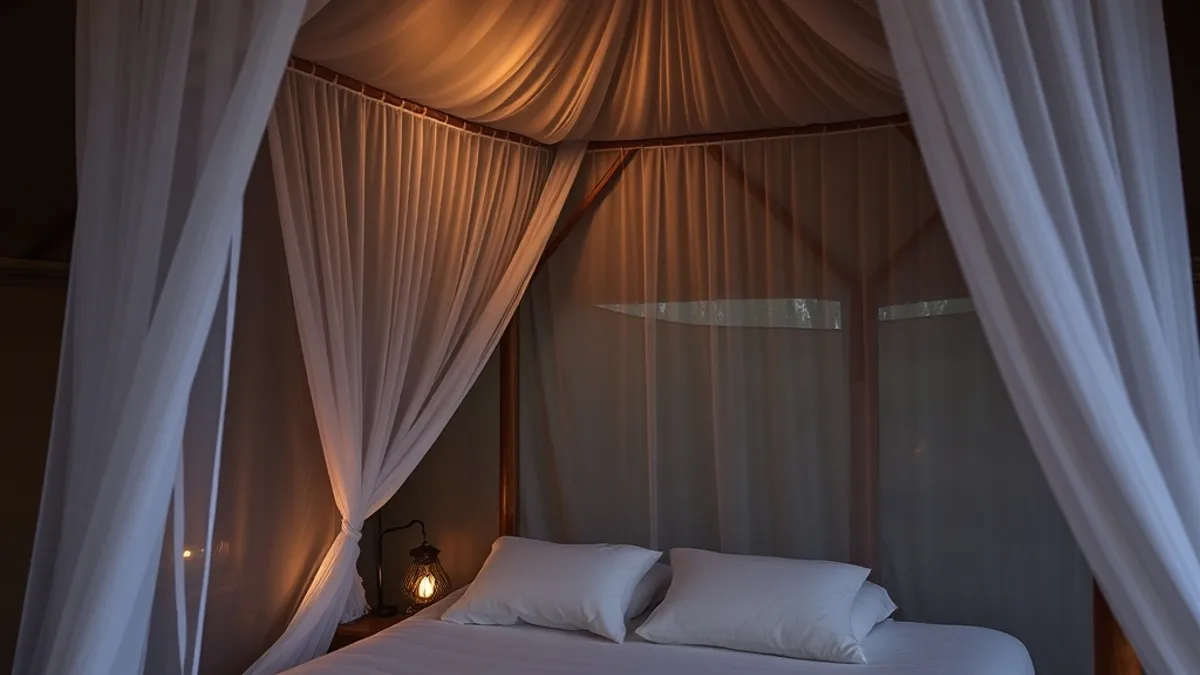
Start by asking whether rooms and tents have screened windows, sealed gaps under doors and around eaves, and ceiling fans or air conditioning to keep air moving. If the lodge markets four-poster beds, confirm the mosquito nets are intact and treated, and whether housekeeping re-tucks them at turndown so they are ready before nightfall. Location within the property matters as well: request a unit away from standing water, and ask whether the lodge runs regular fogging or larvicide programs around camp.
These details are just as relevant when comparing luxury properties, including the kind of upscale safari villas with infinity pools in South Africa that travelers often assume need fewer practical checks.
Beyond the room itself, ask what the lodge provides or encourages in the evenings:
- Repellent supply: whether a DEET-based or equivalent repellent is stocked in every unit or only sold at the camp shop, and whether it is replenished daily.
- Plug-in vaporisers: whether each room has one, if tablets or refills are provided for your whole stay, and what happens if you run out mid-trip.
- Evening dress guidance: whether staff encourage long sleeves and long trousers at dinner and on evening drives, and whether the dress code makes that comfortable in warm months.
Medical Support and Emergency Planning at the Property
Good room protection reduces your chances of being bitten, but a well-run lodge also plans for the worst case. Before you pay a deposit, find out exactly what happens medically if a guest falls ill on site. The answers will tell you a great deal about how the property is run overall.
Start with distance and access. Ask how far the nearest clinic or hospital is and whether the lodge has a doctor or nurse on call. Lodges in malaria-risk zones commonly sit within 10-30 km of a clinic or airstrip for medical evacuation, so ask the property to confirm its own figures rather than guessing. In remote parks, that airstrip may matter more than the hospital itself.
Evacuation cover and insurance
Confirm that the property works with an air-evacuation service, and then check whether your travel insurance covers medical evacuation in that country and region. Some policies exclude certain activities or remote areas, so read the fine print before you travel and carry the emergency numbers with you.
Staff training and testing
Finally, ask whether staff are trained to recognize malaria symptoms such as fever, headaches and chills, and how quickly a guest could be tested on site. Some lodges keep rapid test kits and can test within hours, while others rely entirely on outside facilities. Knowing the difference helps you judge how seriously the lodge takes guest health, and gives you realistic expectations if you ever need care during your stay.
Prophylaxis and Pre-Trip Health Prep: Your Own Checklist
The single most useful thing you can do for your safari is book a travel-medicine consultation well ahead of time. Most clinics recommend seeing a specialist 4-6 weeks before departure, which gives you enough room to test how your body responds to a prophylaxis and to sort out any alternatives if the first option causes side effects. Bring your exact itinerary, including the reserve or park names, so the practitioner can match the drug to your destination rather than to the region in general.
Once you have a prescription, build the schedule into your calendar before you leave home. Anti-malarial courses typically start 1-2 weeks before travel and continue 1-4 weeks after you return, and the after-travel doses are the ones travelers most often forget. Set phone reminders for every dose, and keep the tablets in your carry-on luggage rather than a checked bag.
Costs vary by drug, so ask the pharmacy for the full price before you commit. For a typical 7-10 day safari, expect to budget roughly $30-100 per person depending on which prophylaxis is prescribed.
Some travelers should reconsider the destination itself rather than the medication. Health authorities generally advise against taking young children or pregnant travelers into malaria-risk zones, because the disease hits these groups hardest.
- Discuss your full medical history at the consultation, including any heart, liver or psychiatric conditions, since these can rule out certain anti-malarial drugs before you ever pack.
- Ask about drug interactions if you take regular medication such as anticonvulsants or anticoagulants, as some prophylaxis options conflict with common prescriptions.
- Confirm the pediatric dosing with the clinician if older children are coming along, because children’s doses are calculated by weight and differ from adult tablets.
- Ask what side effects to expect and which ones justify switching drugs, so you know the difference between a mild adjustment period and a reason to call the clinic.
Timing Your Stay: Season, Rates and Malaria Precautions at Safari Lodges
Every safari booking is a trade-off, and malaria risk sits right in the middle of it. The dry season from May to October brings lower mosquito activity, thinner vegetation and prime game viewing around water sources. The green season from November to April is the wet, high-transmission window, but it also brings lower rates, dramatic skies and newborn animals. There is no wrong answer, only an informed one.
Getting the best of both
If your dates are flexible, ask lodges directly about shoulder-season deals that sit at the edge of the low-risk window. The weeks just after the rains end, or just before they begin, often come with discounted rates while mosquito numbers are still dropping or not yet climbing. Lodge managers know their own seasonal patterns better than any booking site, so a short email asking about shoulder-season availability can pay off twice: in price and in comfort.
Protecting the evening hours
Whatever season you choose, remember that Anopheles mosquitoes bite mainly between dusk and dawn, roughly 6 pm to 6 am. That makes evening game drives, sundowners and open-air dinners the hours that need the strictest protection. Apply repellent before the sun goes down rather than after the first bite, and favor long sleeves and trousers for dinner. If the lodge lights the boma fire and offers a pre-dinner drive, ask staff to close and net your room before you leave for the evening, so your sleeping space is sealed by the time you return after dark.
Red Flags and Green Flags When Comparing Lodges
How a lodge answers malaria questions tells you a lot about how it runs everything else. A professional booking team should reply to your questions about nets, screening and repellent quickly, clearly and in detail. Better still, they should put those answers in writing, either in the pre-arrival information pack or in an email you can refer back to. That written record matters if you arrive to find a torn net or a missing vaporiser and need to raise it at check-in.
On the other side of the ledger, watch for hesitation. If a reservation agent cannot describe the condition of the nets, has no evacuation plan to share, or waves off your prophylaxis questions with “you’ll be fine,” treat it as a warning about the property’s overall standards. Lodges in genuine malaria zones take the issue seriously, and their staff are used to these questions.
The strongest signal comes at check-in. Good lodges in risk zones brief arriving guests on the local situation, show them how the nets fasten, and keep repellent and plug-in vaporisers stocked in every unit rather than only on request.
- Green flag: the lodge supplies repellent and vaporisers in every unit as standard, so you are protected from the first evening even if your own supply is still in your checked luggage.
- Green flag: staff re-tuck and inspect nets at turndown service, which means someone physically checks your sleeping area every night rather than trusting the last guest’s report.
- Red flag: vague or shifting answers about net condition and room screening, especially when the same questions get different replies from different staff members.
- Red flag: no clear evacuation plan or air-evacuation partner, or staff who dismiss prophylaxis advice instead of simply noting that medical choices belong to you and your doctor.
Booking With Confidence: Your Malaria Checklist in Brief
The excitement of picking a lodge and imagining your first game drive is exactly when malaria planning gets forgotten. Before you pay a deposit, confirm the risk level of the exact lodge location and match your travel dates to the low-risk May to October window where possible. Then verify room protection, on-site medical support and evacuation cover in writing.
On the personal side, start your health prep 4-6 weeks out with a travel-medicine consultation, and compare lodges on how openly and confidently they answer your questions. A lodge that takes malaria precautions seriously will make that easy; one that brushes you off is telling you something. Have you booked a safari in a malaria zone before, or do you have a question we didn’t cover? Leave a comment or share this article with a fellow traveler.