Glamping near national parks has exploded in popularity, and with it comes a new problem: dozens of tents, domes and cabins now cluster around every park gate, all promising convenience and comfort. In reality, some of them will put you an hour and a half from the trailhead, while others deliver exactly the sunrise-and-stargazing trip you imagined. Knowing which is which before you book is the difference between a great trip and an expensive compromise.
This guide walks you through the decisions that matter most. We’ll look at why your base camp can make or break the trip, how to match the season to the park and the glamping style, and how to weigh distance against price. You’ll also find advice on choosing between tents, domes, yurts and cabins, what to expect from your booking window and nightly rate, how to vet amenities and reviews, and a final checklist to pull it all together before you reserve.
Why Your Base Camp Makes or Breaks a National Park Trip
The single biggest factor in how much you enjoy a national park trip is not the tent itself — it’s where the tent sits. A base camp within 30-45 minutes of the park entrance can put you at a wildlife-rich valley at sunrise, when animals are most active and the roads are nearly empty. Stretch that drive to an hour or more, and you’ll often arrive with the crowds, the full parking lots and the midday heat instead.
Why the gateway towns fill up fast
In-park lodges are the obvious dream, but they typically sell out up to a year ahead, which pushes most glampers toward the gateway towns just outside the gates. That’s not a bad thing — these towns often have better dining, fuel and groceries than anything inside the park — but it means you need to be deliberate about which side of the park you book on.
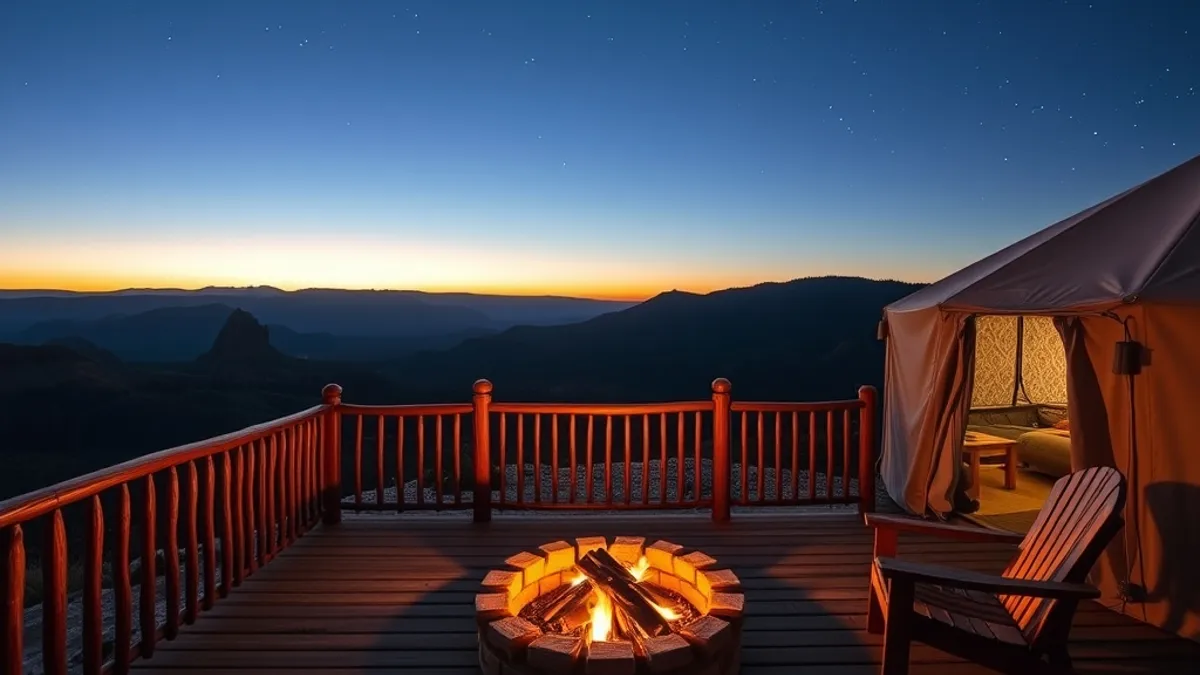
A well-chosen camp also turns your driving time into downtime. Instead of ending each day with a long haul back to a motel, you can be back at camp in half an hour, feet up on a deck, dinner on the fire pit, with genuinely dark skies overhead once the sun drops. That evening rhythm — early start, real dinner, stars before bed — is what makes a glamping base camp worth paying for over a standard room.
Match the Season to the Park and the Glamping Style
Timing shapes everything about a glamping trip: the price, the crowds, and even whether your tent is comfortable at night. For most US parks, the shoulder months of May and September-October hit the sweet spot, bringing milder prices and noticeably thinner crowds than peak summer. Trails are quieter, parking is easier, and camp hosts have more time to help you plan your days.
Desert parks and mountain parks behave differently
Desert parks like Zion and Joshua Tree are at their best in spring and fall, when daytime hiking is pleasant instead of punishing. Don’t assume desert means warm nights, though — summer nights can still drop below 10°C (50°F), so a camp with proper heating matters even in July. Pack layers regardless of the forecast.
Mountain parks such as Yellowstone and Glacier work on a much shorter clock. Their glamping windows are roughly June through September, and operators often open and close with the seasons rather than year-round. If you want a safari tent or dome at elevation, book early within that window and confirm exactly when the site opens and closes for the season, since snow can linger well into spring at higher elevations.
How Close Is Close Enough? Weighing Distance Against Price
Distance is the trade-off at the heart of every glamping booking. Your first priority should be proximity to the entrance you’ll actually use most — not the entrance that looks closest on a map, but the one your trailheads and viewpoints feed into. A camp an hour from the gate you never use is worth less than one twenty minutes from the gate you use daily.
That said, price matters too. Camps sitting 1-2 hours out often cost noticeably less than those right at the park’s doorstep, which can be tempting on a longer trip. But remember that savings come with a cost in time: a two-hour round trip every morning and evening adds up fast, especially if you’re hoping to catch sunrise or beat the parking crunch at popular trailheads.
Before you book anything, do a little entrance homework. Large parks like Yellowstone have gates that are hours apart, so “near Yellowstone” can mean very different things depending on which side of the park your camp sits on.
- Match the camp to the trailhead, not the park name. Search for your top two or three planned hikes and note which entrance or road corridor they start from, then filter camps by drive time to that specific point.
- Check seasonal road closures. Some park entrances and roads close or restrict access outside the main season, which can quietly double your drive time even if the map distance looks short.
- Ask the host for real drive times. Hosts near the parks usually know exactly how long the run to a given gate takes at dawn versus midday, and many can tell you which entrance locals actually use.
- Factor in services along the route. A camp with a grocery, fuel and coffee on the drive in saves you pre-dawn detours; a truly remote site may mean packing dinner and breakfast for the whole stay.
Choosing the Right Structure: Tent, Dome, Yurt or Cabin
The structure you book shapes the whole trip, so think about who is sleeping inside it before you fall for a photo. A family of four crammed into a two-person dome will remember the trip for the wrong reasons, while a couple in a huge safari tent may wonder why half the space goes unused.
For families, safari tents and yurts are the workhorses of the glamping world. Both typically offer real beds for four, room to stand up and move around, and enough floor space for luggage and damp hiking boots. Yurts, with their circular layout and solid walls, tend to feel sturdier in wind, while safari tents give you that canvas-and-campfire atmosphere kids love.
Couples chasing sunrise views and late-night stargazing are better served by geodesic domes and A-frames. Domes often feature a transparent roof panel above the bed, and A-frames frequently pair a compact footprint with a big picture window facing the mountains. Both styles favor atmosphere over square footage, which is exactly the trade-off many couples want.
One warning applies to every structure: ask about heating and insulation before you book, not after you arrive. Desert and mountain nights can drop below 10°C (50°F) even in summer, and a thin canvas wall that feels romantic in July can be miserable in October.
- Safari tents: usually set on wooden platforms with a covered porch, giving you a dry spot to peel off muddy boots before stepping inside.
- Yurts: often include a skylight at the peak of the roof, so you can lie in bed and watch the stars without leaving the warmth of your blankets.
- Geodesic domes: the curved shape sheds wind and light snow well, which makes them a popular choice at higher elevations where weather turns quickly.
- A-frames: typically two-level designs with a small loft ladder, so check whether very young children can safely climb to the sleeping loft.
- Heating to confirm: ask specifically whether the unit has a wood stove, propane heater or electric heat, and whether it runs all night or shuts off on a timer.
Booking Windows and What $150-500 a Night Should Include
Glamping near popular US national parks works on a simple rule: the closer to summer, the earlier you book. Reserve 3-6 months ahead for summer dates, and longer if your dates overlap a holiday weekend. The most photogenic units, the ones with the dome roof panel or the deck facing the valley, are usually the first to go, and hosts often release their full season at once.
Shoulder-season trips are more forgiving. In May and September-October, when prices soften and crowds thin, you can often book a few weeks out and still have a good selection. That flexibility is one of the quiet perks of traveling outside peak summer.
What your money should buy
Glamping tents and domes near major parks typically run $150-500 per night, and that range should come with real comfort, not just a canvas roof. At the minimum, expect quality bedding with proper linens, a private or en-suite bathroom, and either kitchen access or breakfast included. If a listing at the top of that range offers a shared bathhouse a short walk away, ask yourself whether you want to cross a gravel path at midnight in October.
Also look at what sits behind the headline rate. Some sites bundle firewood, kayaks or guided walks into the nightly price; others charge for each extra. Ask before booking so you can compare sites on the true total.
Read the fine print on cancellations
Remote glamping sites often enforce stricter cancellation policies than hotels, partly because a single tent represents most of the host’s inventory for that night. Some offer a full refund only if you cancel weeks in advance, and a few treat weather as your problem, not theirs. Before you pay, note the deadline, the refund percentage and whether the host offers credit toward a future stay if you have to rebook. A screenshot of the policy at booking time saves arguments later.
Vet the Site: Amenities, Connectivity and Reviews That Matter
Photos sell a glamping site; reviews tell the truth. Before booking, scroll past the five-star praise and search recent reviews for specifics: how clean the tent actually was, whether mice got into the food storage, and whether the “secluded” dome sits beside a highway you can hear all night. Reviews from the last few months matter most, since a change in host or management can transform a site within a single season.
Wildlife mentions deserve a close read too. A review that says “elk walked through camp at dawn” is a selling point; one that says “raccoons opened our cooler” is a packing instruction. Both tell you something the listing photos never will.
Then confirm the boring essentials directly with the host, ideally in writing. Ask whether drinking water is provided or whether you should bring your own, whether heating or cooling is available for the nights you will be there, and exactly how check-in works. At remote sites, a missing gate code or an unmarked dirt-road turnoff can cost you an hour of daylight you planned to spend on the trail.
Finally, decide before you book how disconnected you want to be. Many glamping camps have no Wi-Fi or cell signal at all, which is either the point of the trip or a serious problem depending on your plans.
- Potable water: ask whether it comes from a tap in your unit, a shared spigot or a delivered jug, and whether there is enough for cooking as well as drinking.
- Heating and cooling: confirm what handles both ends of the range, since a wood stove will not help you in an August heat wave and a fan will not help you on a cold mountain night.
- Check-in instructions: ask whether you get a gate code, a lockbox or a person to meet you, and whether late arrivals after dark are supported at all.
- Connectivity: ask the host which carriers get signal on the property, and whether there is one spot on site where a call can be made in an emergency.
- Power supply: find out if electricity is continuous or limited to solar with evening hours, which affects charging cameras, headlamps and CPAP machines.
- Food storage: in bear country, ask whether the site provides bear-proof lockers, because keeping food in a canvas tent is not an option.
The Wrap-Up: Your Base Camp Checklist
With dozens of glamping sites scattered around every park gate, the trick to choosing well is simple: work in order. Pick your season first, since May or September-October usually means milder prices and thinner crowds. Then settle on a spot close to the entrance your trailheads actually use, and book 3-6 months ahead for summer dates near popular parks.
From there, match the structure to your group — yurts and safari tents for families, domes and A-frames for couples — and vet the site’s heating, water and reviews so that $150-500 a night truly buys the experience you expected. Get those steps right and your camp stops being a compromise and becomes part of the trip. Have a spot that worked brilliantly for you? Share it in the comments or pass this article along.