Many travelers book villas advertised as “accessible” only to arrive and find a single step at the entrance ruins the entire stay. A ground-floor bedroom is not the same as a step-free property, and the difference can decide whether your trip works at all. Accessible villas do exist in real numbers, but finding one takes more than trusting a listing label.
This guide walks you through the whole process. We start by explaining what “accessible” actually means in villa listings, then cover the essential features to check before booking, the questions worth asking hosts, and the red flags hiding in photos and descriptions. From there, we look at where step-free villas are easiest to find, share a practical booking strategy, and finish with final thoughts on securing a stay that genuinely works for you.
What ‘Accessible’ Really Means in Villa Listings
The word “accessible” is used loosely across villa listings, and that is where most disappointment begins. For many hosts, it simply means there is a bedroom on the ground floor. That helps, but it says nothing about the entrance, the bathroom, or whether a wheelchair can actually move around the property. A villa with one step at the door is not step-free, no matter how the listing describes it.
What a genuinely step-free villa looks like
A truly step-free villa has a level entry from parking or drop-off to the front door, doorways wide enough at 80-90 cm for most wheelchairs to pass comfortably, and no threshold higher than 2 cm anywhere along the route. Those numbers matter, because a doorway that is “wide” to an able-bodied host can be impassable with a chair and a bag.
Three phrases, three different promises
Pay attention to the exact wording in a listing. “Wheelchair friendly” often means the host thinks a chair could manage, with no verification behind it. “Step-free access” usually refers only to the entrance, not the bathrooms or terraces. “Mobility accessible” is the strongest of the three, but even then, ask what it means in practice. They are not the same promise, and treating them as interchangeable is how travelers end up stranded at the front door.
Essential Features of Accessible Villas to Check Before Booking
Before you book any villa, check the four areas that decide whether a stay is genuinely usable: the entrance, the bathroom, the pool and the interior layout. Hosts often get one of these right and assume the whole property is accessible, so it pays to go feature by feature. Whether you are browsing jungle villas with infinity pools in Ubud or a coastal rental closer to home, the same checklist applies.
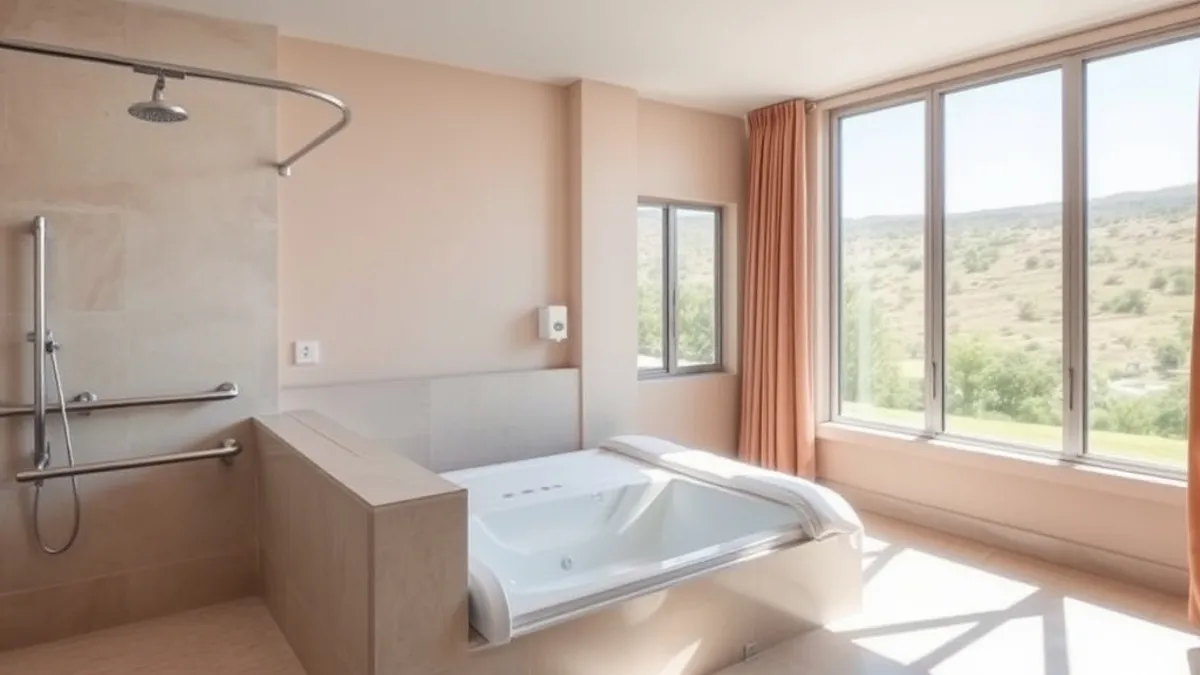
The entrance is the first test. A safe ramp gradient is roughly 1:12, meaning 1 cm of rise per 12 cm of length, or ideally a completely level entry. A portable ramp laid over existing steps is not an acceptable solution — it is unstable, steep and often too narrow. The bathroom matters just as much, since roll-in showers typically need at least 150 x 90 cm of floor space, and grab bars must be load-bearing rather than decorative. Inside, doorways of 80-90 cm and enough turning space make the difference between independence and needing help with every room.
- Entrance: check that the ramp is a fixed, permanent structure and that the surface is non-slip in rain, not smooth polished stone.
- Bathroom: confirm a shower chair is provided, and ask whether the shower floor is flush with the bathroom floor rather than slightly raised.
- Pool access: pool hoists or zero-entry pool edges are the two main step-free options; a ladder or a fixed set of steps serves nobody in a wheelchair.
- Interior: look beyond doorways to furniture height and corridor width, since a wide doorway leading into a cramped room still creates problems.
Questions to Ask Hosts About Step-Free Access
Hosts are usually honest, but they are not accessibility experts, and many genuinely believe their villa is step-free when it is not. A host may have bought a ramp years ago, never seen a wheelchair use it, and assumed it works. Others measure a doorway with the door open, or forget the half-step into the laundry room entirely. The way to close that gap between what hosts believe and what a wheelchair user actually needs is to ask precise questions and get verifiable answers. Treat the exchange as a checklist rather than a conversation, and keep every reply on record.
- Request a video walkthrough of the entrance route. Ask the host to film from the parking spot or drop-off point all the way to the front door, in one continuous take. This shows gradients, surfaces and any obstacle that a photo carefully framed to hide would never reveal.
- Ask whether any single step exists anywhere on the property. Include terraces, pool areas, garden paths and the route between bedroom and bathroom. One 5 cm step onto a terrace is enough to break an otherwise step-free stay, so the answer needs to cover the whole property, not just the entrance.
- Request exact doorway measurements in centimetres. The word “wide” means different things to different people. Ask the host to measure each doorway a wheelchair needs to pass through, including the bathroom, and to confirm the numbers in writing.
- Ask how the grab bars are mounted. Bars screwed into wall studs hold real body weight; adhesive-mounted bars fail under exactly the load they are meant to support. A host who knows the difference is usually a host who has thought the property through.
Send these questions as a single written message rather than over the phone, so the answers arrive in a form you can forward, save and refer back to. If a host hesitates to measure something as simple as a doorway, that hesitation tells you what a site inspection would.
A host who answers promptly and specifically is showing you how they will handle any issue during your stay. Vague or evasive replies are just as informative in the other direction, and it is far better to learn that before paying a deposit than after arriving with a wheelchair at a villa you cannot enter.
Red Flags in Villa Photos and Descriptions
Photos can tell you more than a listing description ever will — but only if you read them critically. The most common trap is a gallery full of sunset shots, infinity pools and panoramic terraces, with not a single image of the front door, the driveway or the bathroom. If a host has invested in genuine accessibility, they almost always show it off. A bathroom and entrance that never appear on camera deserve a direct question before you go any further.
Word choice matters just as much. Descriptions are often written to sound reassuring without actually promising anything, and certain phrases are reliable giveaways that the property has steps somewhere you will have to deal with.
- “Mostly accessible” — the word “mostly” is doing heavy lifting here; it usually means one or two key areas, often the bathroom or a terrace, still have a step or a narrow door.
- “A few steps to the entrance” — this is a direct admission that the villa has steps, however appealing the rest of the property sounds. Treat it as a dealbreaker if you need a fully level route from arrival to door.
- Stock images of grab bars or ramps — if a grab bar or ramp appears in a polished, generic-looking image but never in the real property photos, ask the host to photograph the actual fixture in place.
- No mention of parking or drop-off — a villa can have a perfectly level entrance and still be unreachable if the last stretch is a 50 m gravel path or a sloped driveway; ask exactly where a vehicle can stop and what the surface is like from there to the door.
None of these signs alone means you should walk away, but two or three of them together should make verification non-negotiable. Ask for specifics in writing, and treat vague answers as an answer in themselves.
Where Step-Free Villas Are Easiest to Find
Some destinations make your search dramatically easier than others, and the difference usually comes down to terrain and building age rather than any local accessibility law. Knowing where step-free villas cluster saves weeks of filtering through listings that look promising and disappoint on arrival.
Single-storey layouts do the work for you
The easiest villas to verify are single-storey designs, which are especially common in tropical destinations where villas spread across the grounds as separate pavilions or wings. With no upper floor, there are no internal stairs to negotiate at all, and ground-floor bedrooms come as standard rather than as a special request. You still need to check doorways, bathroom layout and pool access, but the single biggest barrier — stairs — is removed by design.
Newer builds and flat terrain
Age is the second strong signal. Villas built within roughly the last 5-10 years are far more likely to include level entries, wider doorways and roll-in showers, because accessible design has become more mainstream in newer construction. Older properties can be retrofitted, but conversions often produce compromises like portable ramps over existing steps.
Finally, think about the landscape itself. Flat, compact destinations — island flats, beach plains, purpose-built resort areas — suit step-free stays far better than cliffside or hillside locations, where terraced layouts, long staircases and sloped paths are often unavoidable parts of the property. A spectacular view from a hilltop rarely comes with a 1:12 ramp to reach it, so prioritize gentle terrain if step-free access is essential for your trip.
Booking Strategy for Accessible Villas
Even a genuinely accessible villa can turn into a stressful trip if the details were never confirmed in writing. Accessible inventory is limited, hosts change, and memories of a phone conversation are hard to enforce later. A deliberate booking process protects you at every stage, from the first enquiry to the moment you pay your deposit.
- Start your search early. Truly accessible villas are a small share of total inventory, and they tend to sell out first, often to repeat guests who already know the property works for them. Booking 3-6 months ahead gives you the widest choice instead of whatever is left.
- Ask your detailed questions before committing. Send the host your full list — entrance route, doorway measurements in centimetres, bathroom layout, pool access — and see whether the answers are specific or evasive. Vague replies at this stage rarely improve later.
- Request photos or a video walkthrough before paying any deposit. Ask the host to film the whole arrival path, starting at the car park or drop-off point and ending at the front door, plus the bathroom and pool area. Keep the reply on record; it is your reference point if anything does not match on arrival.
- Get every feature written into the booking notes. A verbal promise carries no weight if a host changes or a platform dispute arises. Ask for the confirmed features — level entry, roll-in shower, load-bearing grab bars, pool hoist or zero-entry edge — to be added to the booking notes or confirmation message.
Follow this sequence and you arrive with documented commitments rather than assumptions. Written confirmations also give you something concrete to point to if you need to request a refund or a rebooking, because platform support teams respond far better to saved messages than to recollections of a phone call.
Finally, treat a host’s hesitation as useful information. If someone stalls when you ask to put accessibility features in writing, that reluctance usually means the details were never as solid as the listing suggested — and it is far better to learn that before paying than after you land.
Final Thoughts on Finding Accessible Villas
That single step at the entrance, the one that can undo an otherwise perfect trip, is exactly what this whole process is designed to prevent. A genuinely step-free stay comes down to verifying the details that actually matter: a level or gently ramped entrance, a roll-in shower with grab bars that can take real weight, doorways wide enough for a wheelchair to pass through, and pool access that does not depend on steps or a ladder. Once each of these has been confirmed in writing, the word “accessible” in a listing stops being a gamble and starts being a promise you can hold the host to.
Video walkthroughs and written confirmations will protect you far better than any listing description, and reserving well in advance gives you the widest choice of villas that are truly accessible rather than loosely labeled. If you have stayed in a step-free villa that worked well for you, share your experience in the comments or pass this article along to someone planning their own accessible trip.