You found a hotel that looks perfect, the booking site says “accessible,” and the photos show a bright, modern bathroom. Then you arrive, and the “accessible” room turns out to have a tub instead of a roll-in shower, a doorway too narrow for your chair, or three steps between the elevator and the restaurant. This happens constantly because labels on booking platforms are vague, and photos rarely show the details that matter most.
The good news is that a short verification routine can prevent almost all of these surprises. In this guide, you’ll learn how to verify hotel accessibility before you pay a deposit: why the “accessible” filter alone isn’t enough, how to dig into the hotel’s own details and guest reviews, exactly what to ask when you call, which features to confirm for your specific needs, how to book early and lock in the right room, and what to do if something goes wrong on arrival day. Follow these steps and you’ll check in with far fewer unknowns.
Why ‘Accessible’ on a Booking Site Is Not Enough
That “accessible” filter on a booking site is a blunt tool. In many cases, a hotel earns the label even if only the front entrance or a single bathroom meets any accessibility standard. The rest of the property, including the room you’re actually booking, may be nothing like what you need. The filter tells you a hotel has made some effort, not that your specific requirements will be met.
Older properties are the biggest risk
Historic and older hotels are especially tricky. A property may have installed a ramp at the front door years ago and considered the job done, while the corridors, restaurant, bar and pool area remain reachable only by steps. I’ve seen charming boutique hotels where the accessible room itself is fine, but getting to breakfast requires navigating a staircase. If step-free access throughout the property matters to you, treat the entrance ramp as the start of the conversation, not the end of it.
Standards vary by country
Definitions also differ from country to country. A room marketed as “barrier-free” in Europe might have a wide doorway and a level threshold but lack the grab bars, raised toilet seat or roll-in shower that a US traveler expects under familiar accessibility standards. Some countries have no enforceable definition at all, so the word “accessible” means whatever the hotelier decides it means. That’s why the rest of this article focuses on verifying concrete details yourself rather than trusting a label.
Start With the Hotel’s Own Accessibility Details
Before you pick up the phone, let the hotel’s own materials do some of the work. Well-run properties usually publish a dedicated accessibility page on their website, and the level of detail on that page tells you a lot about how seriously they take accessibility. A vague paragraph is a warning sign; a page listing room dimensions, doorway widths and bathroom layouts is a good sign that the staff can answer follow-up questions accurately.
Photos deserve equal scrutiny. Most hotel galleries lead with the lobby, the pool and the best standard rooms, so you may have to dig to find images of the actual accessible room type. If you can’t find a photo of the accessible bathroom, that’s a gap worth asking about directly.
Guest reviews are often the most honest source of all. Recent reviews from travelers with similar needs reveal what the property is really like day to day, beyond marketing language. When scanning reviews, look for these specifics:
- “Roll-in shower” — confirms the bathroom has a step-free shower, not just a shower over a tub, which is a common mismatch between photos and reality.
- “Wheelchair” — reviews mentioning wheelchair use often describe doorway widths, bed heights and how easily the guest moved around the room and common areas.
- “Grab bars” — mentions of grab bars (or their absence) tell you whether the bathroom was built or retrofitted to a real standard.
Pay attention to how recent the reviews are. A review from three years ago may describe a room that has since been renovated, or an accessible room that has been reassigned to general inventory. Prioritize reviews from the last year or two, and note whether the hotel responded to any accessibility complaints.
Call the Hotel and Ask the Right Questions
A phone call is where vague listings get sorted into firm answers. Websites compress a hotel into filters and photos, but a direct conversation lets you confirm the details that actually shape your stay. Front desk staff can check the specific room you would be assigned, walk you through the bathroom layout, and flag issues no listing page mentions. A good call also tells you something about the hotel itself: a property that takes your questions seriously before you book will usually take them seriously after you arrive. Aim to call the hotel directly at least 2-4 weeks before booking, when rooms are still available but your dates are firm. Give yourself 15-20 minutes, have your dates and room preferences ready, and work through the questions below in order.
- Confirm the shower type for your exact room. Ask whether the specific room type you want has a roll-in shower or a tub. Hotels often have both configurations, and booking “an accessible room” without specifying can land you in a tub room by default.
- Request exact measurements. Ask for doorway widths, bed height and bathroom clearance in inches or centimeters, not adjectives like “spacious.” This matters more than many travelers expect, because standard US interior doorways are often 23-28 inches wide while wheelchair users typically need 32 inches or more. If the staff can’t provide numbers, ask them to measure and call you back — a hotel that refuses this request is telling you something.
- Walk the route from parking to the room. Ask about the path from accessible parking or the drop-off point to your room, including any steps, steep ramps, or gaps where a ramp connects to a lift. A beautiful accessible room is useless if the route to it involves a staircase.
- Get it in writing. After the call, send a follow-up email summarizing every feature the staff promised — shower type, measurements, step-free route — and ask them to confirm. Verbal assurances can vanish at check-in; written email confirmation gives you something to show at the front desk if anything was reassigned.
Keep that email thread handy through check-in day. If the staff member you spoke with is off shift, the written record lets any colleague honor the same commitments, and it removes the awkward “I was never told that” conversation from your arrival. Ten minutes of extra effort before booking is the difference between a smooth check-in and a scramble to find another room.
Verify Hotel Accessibility Features That Matter Most to You
Once you have confirmed that an accessible room actually exists, the next step is making sure it fits your specific needs. Accessibility means different things to different travelers, and a room that works perfectly for one guest can be frustrating for another. Break your requirements down by category and verify each one directly with the hotel.
If you are a mobility traveler, ask about the bed height first. A bed that is too high to transfer onto, or too low to stand up from easily, can shape your entire stay. Confirm the turning space in the room and bathroom is around 60 inches so a wheelchair can maneuver comfortably, and check that light switches, thermostats and closet rods are within reach from a seated position.
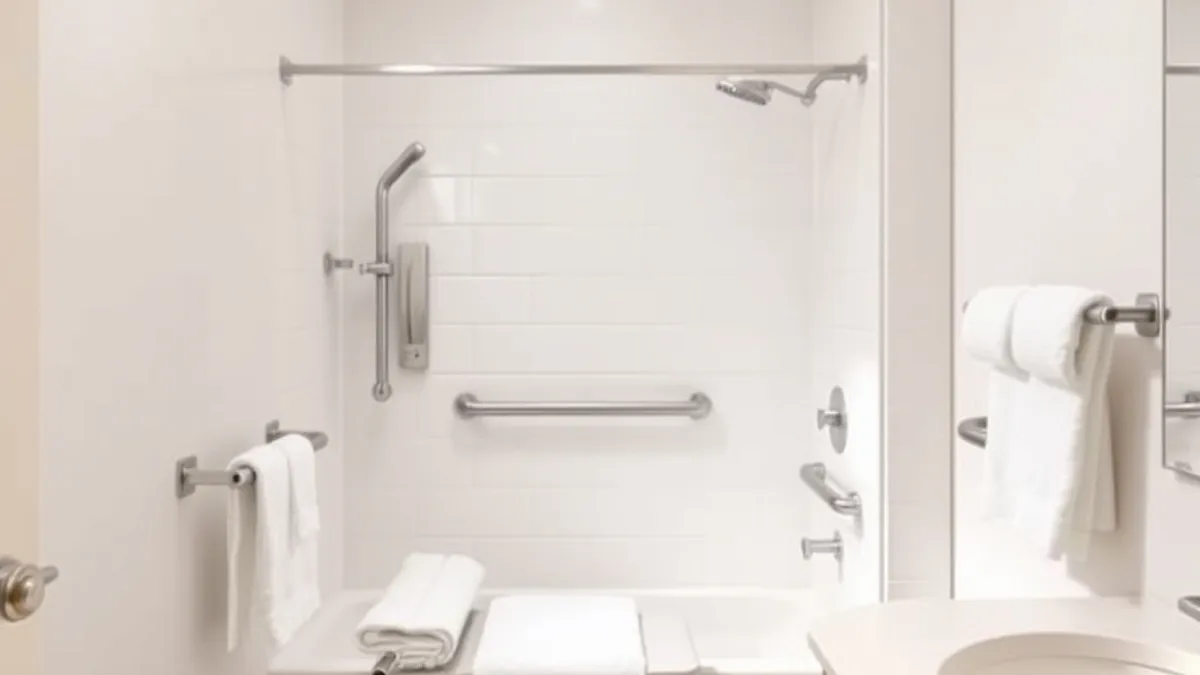
Bathroom details deserve the most scrutiny, because this is where most problems happen. Use the checklist below when you call, and ask the hotel to confirm each item for the exact room type you will be assigned, not just “our accessible rooms” in general.
- Roll-in shower size: an ADA-compliant roll-in shower is usually around 30 x 60 inches, which leaves room for a wheelchair alongside the bench; ask for the actual dimensions of your room’s shower.
- Grab bar placement: bars near the toilet and inside the shower should be installed at usable heights, and the hotel should confirm they are weight-rated rather than purely decorative towel rails.
- Fold-down bench: a wall-mounted shower bench lets you shower seated, so confirm it exists, locks securely in place and is positioned where you can reach it from your chair.
- Sink height and clearance: a lowered sink with open space underneath lets you roll up close to the basin and reach the faucet and mirror.
Travelers with hearing or vision needs have a different checklist. Ask whether rooms offer visual alarms that flash for fire emergencies, closed-caption television and doorbell or phone signalers. In common areas, look for braille or large-print signage at room numbers and elevators, and confirm the front desk can communicate in writing if needed.
Finally, do not forget the spaces outside your room. Common areas are often overlooked in accessibility descriptions, so ask specifically whether the pool, gym, restaurant and spa are step-free and reachable by elevator. A fully accessible room loses much of its value if the only route to breakfast involves a flight of stairs.
Book Early and Lock In the Right Room
Accessible rooms are usually a small slice of a hotel’s total inventory, often only 5-10% of its rooms. That means they sell out long before standard rooms do, especially in busy seasons and at properties with just one or two accessible units per floor. If you wait for a last-minute deal, you may find plenty of availability in regular rooms and none at all in the one you actually need.
Book as early as your travel plans allow, ideally right after you have called and confirmed the room’s features. Early booking also gives the hotel time to prepare, and it gives you leverage if something goes wrong later, since you reserved the accessible room well before anyone else could claim it.
Put your requirements in writing on the reservation
When you book, attach your accessibility requirements directly to the reservation itself. A general comment field buried in a booking engine is easy for staff to miss, so spell it out: the room type, the roll-in shower, the bed height you discussed and any other features the hotel promised. If you booked through a third-party site, follow up with the hotel directly so your requirements exist in their own system, not just the intermediary’s.
Reconfirm about one week out
Roughly a week before arrival, contact the hotel again by phone or email and reconfirm that the accessible room is still assigned to you. Rooms occasionally get reassigned during busy periods, and a reconfirmation gives the hotel a chance to fix a mistake before you are standing at the front desk. Ask for the confirmation in writing, since an email record of the promised features is far more useful than a verbal assurance if a dispute arises at check-in.
Have a Backup Plan for Arrival Day
Even with careful planning, things can change between the time you book and the moment you arrive. Staff turnover, maintenance issues and simple clerical errors can all affect your room assignment. A solid backup plan turns a potential crisis into a manageable inconvenience, and most of it fits on your phone.
Start by saving your email confirmation where you can find it offline, not just in an inbox you cannot open without Wi-Fi. If the front desk says your accessible room was reassigned, a written record showing the room type and the features the hotel promised gives you something concrete to point to. It is much harder for staff to brush off a request when the confirmation is on your screen.
Before departure, identify one or two nearby hotels that have confirmed accessible rooms, and save their phone numbers in your contacts. Call them ahead of your trip to verify they have accessible availability on your dates, so you are not scrambling to research options from a taxi. A few minutes of preparation gives you a real alternative if your original hotel cannot deliver.
When you arrive, use the checklist below to make your first hour count.
- Inspect immediately, not the next morning: walk into the bathroom and test the shower, grab bars and bench within the first hour, while there is still time to move you to another unit without disrupting your stay.
- Measure the critical clearances: if a doorway or bathroom space feels tight, compare it to the measurements the hotel gave you in writing, since that document supports your request for a different room.
- Ask for a specific alternative unit: if features are missing, request another accessible room by name or number rather than accepting a vague promise that maintenance will “look at it” tomorrow.
- Know your fallback options: if no suitable room exists in the building, you already have the numbers of nearby hotels with confirmed accessible rooms, so you can make the switch on your own terms.
Most stays go smoothly when you have done the groundwork, but the travelers who fare best are the ones who arrive prepared to verify, document and, if necessary, act quickly. Your first hour at the hotel is when you have the most options, so use it.
Your Pre-Booking Accessibility Checklist
Photos and the word “accessible” on a booking site often hide the problems that matter most: a step in the corridor, an entrance your chair cannot get through, or a “roll-in shower” that turns out to be a tub. The good news is that a simple verification routine before you pay removes most of these surprises.
Check the hotel’s own accessibility details, call ahead to confirm measurements, and book early, since accessible rooms make up only a small share of inventory. Get written confirmation by email, and keep a backup plan ready in case something changes before or at check-in. If this routine helped you, leave a comment or share this article with a fellow traveler.